
If you’re searching for web development in Australia and you’re not sure where to begin this guide is for you. Whether you’re building your first website or replacing one that’s been underperforming for years, the decisions you make here will affect how your business shows up online for a long time to come.
Australia has a strong web development market. There are genuinely talented agencies in every major city. But the industry also has its share of operators who will overpromise, underdeliver, and disappear the moment your deposit clears. Knowing how to tell them apart is half the battle.
This guide covers everything a business owner needs to know costs, platforms, what to ask before you sign, and what a professional web development process actually looks like from start to finish.
Table of Contents
ToggleWhat Is Web Development and Why Does It Matter for Australian Businesses?
Web development is the end-to-end process of building a website — from the visual design to the underlying code, the content management system, and the server infrastructure that keeps it running. It’s not just about making something that looks good. A properly built website is fast, secure, easy to update, and structured in a way that search engines can understand.
For Australian businesses, the stakes are real. Over 21 million Australians use the internet regularly, and the overwhelming majority of consumers research a business online before making any contact. Your website is often the very first impression you make — and unlike a shopfront or a phone call, it’s working (or not working) around the clock.
A well-built site generates enquiries, builds trust, and supports your broader marketing efforts. A poorly built one quietly costs you customers every day — and most business owners don’t realise it’s happening until the damage is already done.
Types of Web Development Services in Australia
Before you approach any agency, it helps to know which type of project you’re actually after. The scope, cost, and timeline vary significantly depending on what you need.
Business Websites
The most common type of project. Usually five to fifteen pages covering your services, team, contact details, and supporting content. The goal is to establish credibility and convert visitors into enquiries. A good business website should also be built with SEO foundations in place from day one — not added on later as an afterthought.
E-Commerce Stores
If you’re selling products online, you need more than a contact form and a price list. Shopify and WooCommerce are the two most widely used platforms for Australian e-commerce. Shopify suits businesses that want a hosted, lower-maintenance solution. WooCommerce (built on WordPress) offers more flexibility but requires more ongoing management.
Custom Web Applications
Booking systems, client portals, subscription platforms, member areas, internal business tools — these are custom builds that go well beyond a standard website. They take longer and cost more, but they’re built specifically around how your business actually operates, rather than forcing you to adapt to an off-the-shelf solution.
WordPress Development
WordPress powers more than 40% of all websites globally. In Australia, it remains the most popular platform for business websites because of its flexibility, strong developer community, and the ability for business owners to manage their own content without needing technical skills. Most Australian agencies offer WordPress as a core service.
How Much Does Web Development Cost in Australia in 2026?
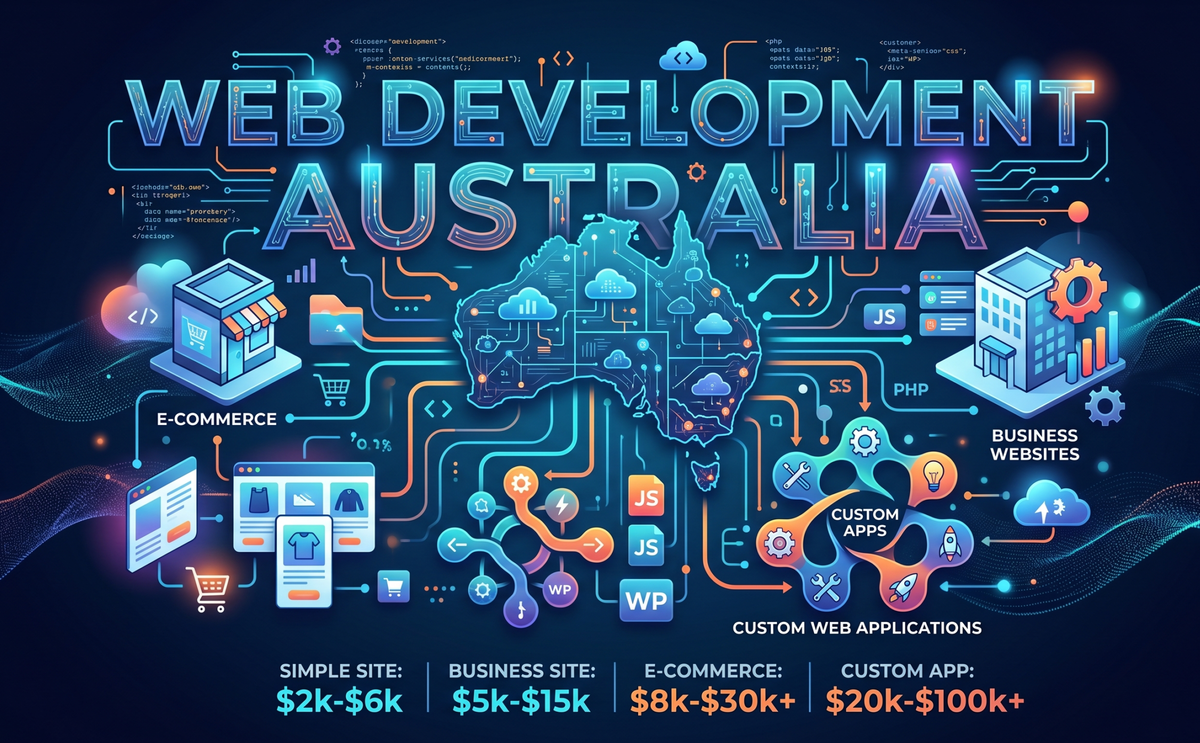
This is almost always the first question — and it deserves a straight answer. Here are realistic mid-market ranges for professional web development in Australia in 2026:
- Simple brochure website (5–8 pages): $2,000 – $6,000
- Business website with CMS and blog: $5,000 – $15,000
- E-commerce store: $8,000 – $30,000+
- Custom web application: $20,000 – $100,000+
These are not freelancer platform rates, and they’re not large enterprise agency rates either. They reflect what a professional, mid-market Australian agency typically charges for quality work.
Be cautious of very cheap quotes. A “$500 website” is almost always a template with your branding dropped in — built quickly, with minimal communication, and no real support once the invoice is paid. The savings look good until something breaks or you need a change and nobody answers your emails.
Also pay close attention to what’s included. Does the quote cover hosting setup? Mobile testing? Basic SEO configuration? Content upload? A CMS training session? These things matter and are often missing from base quotes.
How to Choose the Right Web Development Company in Australia
There’s no shortage of agencies to choose from. Here’s how to sort the good ones from the rest.
Actually Click Through Their Portfolio
Screenshots look nice. Live websites tell the truth. Open the sites in their portfolio on your phone. Are they fast? Do they work properly on mobile? Is the design still holding up or does it look like it was built four years ago and never touched since? This takes five minutes and tells you more than any sales conversation will.
Ask Directly Who Does the Work
Some agencies present as local Australian teams but outsource development offshore. That’s not automatically a bad thing — but you deserve to know upfront. Ask: who will actually build my website? Where are they based? Who is my point of contact throughout the project?
Demand a Detailed Written Proposal
A professional agency will give you a scope of work document that spells out exactly what’s included — pages, features, functionality, timelines, milestones, revision rounds, payment schedule, and post-launch support. If a quote arrives as a single line and a dollar figure, ask for more detail. A vague quote becomes a dispute later.
Verify Reviews Beyond Their Own Website
Testimonials on an agency’s own site are hand-picked. Check Google Business reviews, Clutch.co, or LinkedIn recommendations for a more honest picture. Look for consistent patterns — both the praise and the complaints tell you something useful.
Confirm You’ll Own Everything
Your domain, hosting account, website files, and all content must belong to you at the end of the project. Some agencies retain control over client assets as a way of locking you in. Get written confirmation of ownership before signing anything.
What the Web Development Process Looks Like in Australia
If this is your first website build, here’s a realistic overview of what working with a professional agency looks like:
Discovery: The agency spends time understanding your business, your customers, your competitors, and your goals. This stage shapes every decision that follows. A good agency asks more questions than it answers at this point.
Design: You’ll review wireframes or visual mockups before any code is written. This is your chance to give feedback on layout, structure, and visual direction before it gets expensive to change things.
Development: The site is built — pages coded, CMS configured, features integrated, content uploaded. This is typically the longest phase.
Testing: A professional agency tests across multiple browsers and devices before going live. Desktop, tablet, mobile — it should all work properly. Forms, checkout flows, speed — everything gets checked.
Launch: The site goes live. Expect the agency to monitor things closely in the first 24 to 48 hours.
Handover: You receive your credentials, a walkthrough of how to manage your content, and documentation covering what was built and how to maintain it.
The average cost of web development in Australia in 2026 ranges from $2,000 to $6,000 for a simple brochure website, $5,000 to $15,000 for a business website with a content management system, and $8,000 to $30,000 or more for an e-commerce store. Custom web applications typically start at $20,000 and can exceed $100,000 depending on complexity. Prices vary based on the agency's location, experience, and what's included in the scope of work.
A simple business website in Australia typically takes two to six weeks to build. E-commerce stores and more complex sites usually take six to fourteen weeks. Custom web applications can take anywhere from three to twelve months depending on the scope. Timelines are also affected by how quickly the client provides content, feedback, and approvals — delays on the client side are one of the most common reasons projects run over schedule.
WordPress is the most widely used platform for Australian business websites due to its flexibility, strong SEO capabilities, and large developer community. Shopify is the leading choice for e-commerce businesses. Webflow suits design-focused projects where visual control is a priority. The best platform depends on your specific business goals, budget, and how hands-on you want to be with ongoing content management.
For most Australian businesses, working with a local agency offers clear advantages — overlapping business hours, an understanding of the Australian market and consumer behaviour, and real accountability if something goes wrong. Offshore options can offer lower rates, but the savings are often offset by communication friction, time zone delays, and the need to redo work that missed the brief. For business-critical projects, local is usually the safer choice.
At the end of a web development project, you should receive full ownership and access to your domain name, hosting account, and all website files. You should also receive a handover session covering how to manage your content, login credentials for all platforms, and basic documentation. If an agency is vague about deliverables at handover, clarify this in writing before the project begins.
Many full-service Australian web development agencies offer SEO alongside their development work. The key distinction is whether SEO is genuinely built into the website during development — things like page speed optimisation, proper URL structure, heading hierarchy, schema markup, and mobile performance — or whether it's simply offered as a separate add-on service. Technical SEO foundations should be embedded in the build itself, not bolted on after launch.
