
Australia is home to more than 2.5 million small businesses. If you’re looking for the right small business growth strategies in Australia, you’re already ahead — because most business owners react to problems rather than plan for growth. Competition is real, margins are tighter than ever, and in 2026, the businesses pulling ahead are the ones with a deliberate digital strategy behind them.
The landscape has shifted dramatically over the past few years. Customers now research online before they buy, compare options across multiple platforms, and make judgments about your credibility within seconds of landing on your website. If your digital presence isn’t working hard for you, your competitors’ is — and they’re picking up the customers you should be winning.
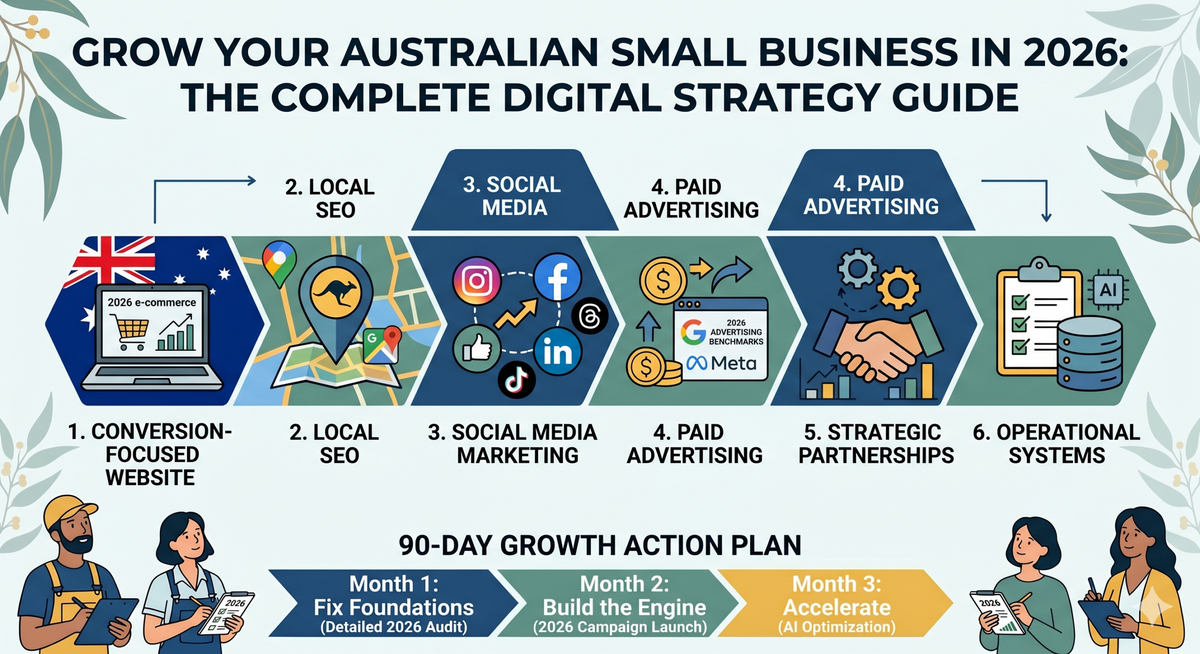
This guide covers the complete picture: website design and development, SEO, social media marketing, paid ads, content strategy, and the business fundamentals that hold it all together. Whether you’re just starting out or looking to scale an established business, these strategies are built for the Australian market in 2026.
Why Digital Is Now the Core of Small Business Growth Strategies in Australia
Ten years ago, word of mouth, local print advertising, and a decent shopfront were enough to sustain a small business. That playbook still has value, but it’s no longer sufficient on its own.
Today, 87% of Australians research products and services online before making a purchase. Google processes over 8.5 billion searches every day — and a significant chunk of those searches are people looking for exactly what your business offers. The question is whether they find you or find your competitor.
Digital marketing gives small businesses something that traditional advertising never could: precise targeting, measurable results, and the ability to scale spend based on what’s actually working. A local tradie in Parramatta can now run a campaign that only appears to homeowners within 10 kilometres. A boutique clothing store in Fitzroy can retarget website visitors across Instagram for cents per impression.
The businesses winning in 2026 aren’t necessarily the biggest ones — they’re the ones with the clearest digital strategy.
Website Design and Development: Your 24/7 Sales Tool
Your website is not a brochure. It’s not a digital business card. When built correctly, it’s your most productive sales asset — working around the clock, answering questions, building trust, and converting visitors into paying customers while you sleep.
The average Australian consumer spends fewer than eight seconds deciding whether to stay on a website or leave. That window is everything. A slow, cluttered, or visually outdated site sends a signal that your business doesn’t take itself seriously — and neither should the visitor.
What a High-Performing Small Business Website Looks Like
There are a handful of non-negotiables for any Australian small business website in 2026:
- Mobile-first design: Over 65% of Australian web traffic now comes from mobile devices. Your site must look flawless and load fast on a phone, not just a desktop.
- Page speed under 3 seconds: Google uses page speed as a ranking factor, and users abandon slow sites. Compress images, use modern hosting, and eliminate unnecessary plugins.
- Clear conversion pathways: Every page should have one primary goal. Book a call, request a quote, fill in a form. Remove friction, reduce distractions, and guide the visitor toward that action.
- Trust signals throughout: Client logos, Google review scores, before-and-after case studies, certifications, and team photos. People buy from businesses they trust.
- Professional copywriting: The words on your site matter as much as the design. Clear, benefit-led copy that speaks your customer’s language outperforms clever design every time.
Custom Website vs Template: What’s Right for Your Business?
Template-based builders like Squarespace and Wix serve a purpose for very early-stage businesses with minimal budgets. But as soon as you’re serious about growth, the limitations become obvious — slow load times, poor SEO architecture, limited customisation, and a design that looks identical to thousands of other sites.
A professionally developed WordPress website gives you full control over performance, design, SEO, and integrations. It’s the platform of choice for the majority of high-performing Australian small business websites — and for good reason.
At PSA Rockwell, every website we build is designed with conversion and search performance in mind from day one. Not as an afterthought.
SEO for Small Business: Get Found on Google
Local SEO: Dominate Your Area
Local SEO focuses on appearing in Google’s Map Pack and local search results when someone nearby searches for your services. It’s the most direct path to new customers for location-based businesses.- Google Business Profile optimisation: Fully complete your profile. Add photos weekly, respond to every review, post updates, and list every service you offer. This profile directly influences your visibility in the Map Pack.
- Local citations: Ensure your business name, address, and phone number (NAP) are consistent across True Local, Yellow Pages, Yelp Australia, and relevant industry directories.
- Location pages: If you serve multiple suburbs or cities, create a dedicated, content-rich page for each location. Thin pages with swapped suburb names don’t work — each page needs genuine, locally relevant content.
- Review generation: Actively ask satisfied customers to leave Google reviews. A business with 50 positive reviews will almost always outrank one with 5, regardless of other factors.
On-Page SEO: What Happens Inside Your Website
On-page SEO covers the technical and content elements within your website that help Google understand what each page is about and who it should be shown to.- Target one primary keyword per page — and use it in your title tag, H1, first paragraph, and naturally throughout the body
- Write unique, descriptive meta descriptions that encourage click-throughs from search results
- Use a logical heading structure (H1 → H2 → H3) that organises your content clearly
- Optimise every image with a descriptive file name and alt text
- Build internal links between related pages to help Google crawl your site and distribute authority
Link Building: Earn Authority from Other Sites
Backlinks — links pointing to your website from other credible websites — remain one of Google’s most important ranking signals. Earning high-quality backlinks from Australian industry publications, local news sites, business associations, and relevant directories accelerates your SEO results significantly. SEO is a long game. Most businesses see meaningful traction within 3–6 months, with compounding results beyond that. The businesses that start early and stay consistent are the ones that dominate their local markets.Social Media Marketing: Build Trust at Scale
Australia has over 20 million active social media users. For small businesses, social media is one of the most cost-effective ways to build brand recognition, generate leads, and stay top of mind between purchases.
The key word here is strategy. Posting randomly when you remember to is not social media marketing — it’s noise. The businesses getting results from social media treat it like a channel with a clear objective, a content plan, and consistent execution.
Choosing the Right Platform for Your Business
- Facebook: Still the largest platform in Australia by active users. Excellent for local businesses, community building, and targeting older demographics (35+). Facebook Groups and Business Pages with consistent posting can drive significant organic engagement without paid spend.
- Instagram: A visual platform built for industries where appearance matters: hospitality, retail, beauty, property, interior design, and trades. Short-form video (Reels) is currently receiving the highest organic reach of any Instagram content format.
- LinkedIn: The go-to platform for B2B businesses, consultants, and professional services. A well-maintained LinkedIn presence builds credibility and generates warm inbound enquiries from decision-makers.
- TikTok: Growing rapidly in Australia, particularly for reaching consumers under 40. Authentic, behind-the-scenes, and educational content performs extremely well. Several Australian small businesses have built significant audiences from scratch with zero ad spend.
- YouTube: Underutilised by most small businesses, yet highly valuable. How-to videos and explainer content rank in both YouTube and Google search, giving you two discovery channels from one piece of content.
What to Post: Content That Actually Works
The most effective social media content for Australian small businesses falls into three broad categories:
- Educational content: Tips, how-tos, and answers to common customer questions. This builds authority and gets shared.
- Social proof: Customer testimonials, case studies, before-and-after results, and reviews. This builds trust and reduces purchase hesitation.
- Behind-the-scenes content: Your team, your process, your day-to-day. This builds connection and humanises your brand in a way that no polished ad can replicate.
Consistency matters far more than volume. Three well-crafted posts per week, published reliably over twelve months, will outperform seven rushed posts per week that stop after sixty days.
Paid Advertising: Accelerate What's Already Working
Google Ads for Small Business Australia
Google Search Ads place your business at the top of search results for your chosen keywords. For small businesses targeting high-intent searches like “emergency plumber Sydney” or “accountant Brisbane small business,” this can deliver an exceptional return on investment. The key is tight campaign structure: specific keywords, highly relevant ad copy, and a dedicated landing page designed to convert. Broad, unfocused campaigns waste budget fast. A well-managed Google Ads campaign with even a modest daily spend can generate a consistent pipeline of qualified enquiries.Meta Ads (Facebook and Instagram)
Meta’s advertising platform offers unparalleled audience targeting. You can reach people based on location, age, interests, behaviour, and even target customers similar to your existing clients (Lookalike Audiences). For brand awareness, lead generation, and retargeting website visitors, Meta Ads remain highly effective for Australian small businesses across virtually every industry. Important: Paid advertising amplifies what’s already working. If your website doesn’t convert, sending paid traffic to it will burn your budget. Fix your website first — then scale with ads.Content Marketing: Become the Authority in Your Industry
Content Formats That Work for Australian Small Businesses
- SEO blog posts: Target specific keywords your audience searches for. A well-written 1,500–2,500 word post on a relevant topic can rank for years and generate consistent organic traffic.
- Email newsletters: Your email list is an asset you own. Unlike social media followers, email subscribers can’t be taken away by an algorithm change. A monthly newsletter keeps your business front of mind with warm leads and past customers.
- Video content: Tutorial videos, client testimonials, and industry commentary perform well across YouTube, LinkedIn, and Instagram.
- Case studies: Detailed write-ups of real client results are among the most persuasive content a service business can produce. They demonstrate proof, not just promise.
Customer Retention: Your Most Underutilised Growth Lever
While most small businesses focus almost entirely on acquiring new customers, research consistently shows that retaining an existing customer costs five times less than winning a new one. Loyal customers spend more, refer others, and are far more forgiving when things occasionally go wrong.
A deliberate retention strategy turns a one-time transaction into an ongoing relationship — and ongoing relationships are the foundation of sustainable business growth
- Post-service follow-up — A simple check-in call or email after a job shows customers you care beyond the invoice. It also surfaces any issues before they become negative reviews.
- Loyalty and referral programs — Reward repeat customers and people who send you referrals. A formal program, even a simple one, dramatically increases both repeat purchase rates and word-of-mouth volume.
- Regular email communication — Monthly newsletters, seasonal promotions, and helpful tips keep your brand relevant between purchases. Out of sight is out of mind.
- CRM implementation — A customer relationship management system lets you track every interaction, set follow-up reminders, and ensure no lead or client falls through the cracks.
Frequently Asked Questions
For most Australian small businesses, local SEO combined with a high-converting website delivers the strongest long-term ROI. These two elements work together — SEO brings qualified traffic, and a well-designed website converts that traffic into enquiries and sales. Social media marketing and paid advertising then amplify results once the foundation is solid.
A common benchmark is 7–10% of annual revenue, though this varies significantly by industry and growth stage. A business targeting rapid growth may invest more in the short term to capture market share. Start with a defined budget, measure results carefully, and increase spend on what's working.
Most businesses see meaningful improvement in rankings and traffic within 3–6 months of consistent SEO work. Competitive industries or newer websites may take 6–12 months. The results compound over time — a page that ranks well in month six will often outperform in months twelve, eighteen, and beyond.
Template builders like Squarespace and Wix are fine for very early-stage businesses with minimal budgets. However, they have real limitations in SEO performance, page speed, and customisation. For a business serious about growth, a professionally built WordPress website is a worthwhile investment that pays for itself through improved conversions and search visibility.
It depends on your industry and target audience. Facebook remains the largest platform in Australia by users and is effective for most local businesses. Instagram suits visual industries. LinkedIn is essential for B2B and professional services. The best approach is to pick one or two platforms where your audience is most active and show up consistently, rather than spreading effort thinly across all channels.
