

Imagine you have built a beautiful, modern shop stocked with the best products in the world. You have hired friendly staff and set up amazing displays. But there is one major problem: you built this shop in the middle of a dense forest where there are no roads. No matter how good your shop is inside, if customers cannot find the road to your door, your business cannot grow.
In the online world, this is exactly what happens if you launch a website without a strategy for Search Engine Optimization (SEO).
For business owners, students, and marketing beginners, the question is no longer “What is SEO?” The real question you should be asking is, “How many customers am I losing every day by ignoring it?” Think of SEO as the signboard, the highway, and the roadmap that guides customers straight to your digital doorstep.
Below, we explain simply why SEO is important, how it helps people trust your brand, and why it remains the most cost-effective marketing investment you can make in 2025.
1. Organic Search is the Main Source of Website Traffic
“Organic search” simply refers to the free results you see on Google—the ones that are not ads. To understand why this is so critical, think about your own daily habits. When you need an answer to a question, need to find a service, or want to buy a new product, what is the very first thing you do? You probably open Google and type in a search query.
You are not alone in this behavior. Studies consistently show that organic search drives more than 50% of all visitors to websites. This is much higher than the traffic that comes from social media (like Instagram or Facebook) and other sources combined. While social media is great for entertainment, Search is for finding answers.
The Difference Between "Scrolling" and "Searching"
There is a big difference in intent. When people are on social media, they are usually there to relax or connect with friends; they might not be looking to buy anything. However, when someone types “best running shoes” into Google, they are actively looking for a solution.
- High Intent: Search visitors are actually looking for what you offer right now.
- Better Conversion: Because they are looking for you, they are more likely to become paying customers than someone who just stumbled across your post on Instagram.
If you ignore SEO, you are basically giving all those customers to your competitors who are on page one.
The "Page One" Rule
- Visibility: If you rank high, you are the first option a customer sees.
- Free Traffic: High rankings bring a steady flow of customers without you having to pay for every single click.
2. SEO Builds Trust and Credibility
One of the most valuable benefits of SEO is that it makes your business look professional and trustworthy. There is a psychological factor at play here: People trust Google.
If Google’s smart computer system (the algorithm) decides to put your website at the very top of the list, it sends a powerful signal to the user. It tells them, “Google thinks this is the best, most relevant, and safest answer to your question.”
The "Vote of Confidence"
- First Impressions: Users subconsciously perceive top-ranking sites as “market leaders.” If you are buried on page 3, users might wonder if your business is new, small, or inactive.
- Brand Awareness: Even if a user doesn’t click on your website the first time, seeing your name at the top for different searches makes them remember you.
Skipping the Ads
Have you ever searched for something and deliberately scrolled past the results marked “Sponsored” or “Ad“? Many modern users have developed “ad blindness.” They ignore the paid spots because they know those companies paid to be there. They go straight to the first organic result because they trust that the website earned that spot through quality and relevance.
Building this authority takes time—you need to write helpful articles, get other websites to link to you (backlinks), and have a secure site—but once you have it, that trust is an asset that money cannot buy.
3. SEO Improves User Experience (UX)
Many beginners make the mistake of thinking SEO is just about “tricking” the computer by repeating keywords (like “best pizza shop”) over and over in white text. That is an old tactic that no longer works. Today, Google cares most about the human user.
Google wants to show its users the best possible websites. Therefore, to rank well in 2025, your website must be fast, helpful, and easy to use. This means that Good SEO = Good User Experience.
How SEO Fixes Your Website
When you hire an expert to improve your SEO, they don’t just look at words; they look at how your website functions.
- Loading Speed: Does your page open in under 3 seconds? If it takes too long, users will get frustrated and hit the “back” button. Google knows this and will lower your rank.
- Mobile Friendly: More people search on phones than on laptops. If your site looks tiny or broken on a mobile screen, you will lose rankings.
- Easy Navigation: Can people find the “Buy” or “Contact Us” button easily? A messy website confuses Google and visitors alike.
Reducing the “Bounce Rate”
In SEO terms, a “bounce” is when someone visits your site and leaves immediately without clicking anything. A high bounce rate is bad. By optimizing your content to be easy to read (using headings and bullet points) and making your site fast, people stay longer. The longer they stay, the more likely they are to buy. Key Takeaway: Good SEO equals a happy visitor. If your site is fast and helpful, people will stay longer.4. SEO vs. Paid Advertising: Renting vs. Owning
A common debate in marketing meetings is: “Should we do SEO, or should we just pay for Google Ads (PPC)?”
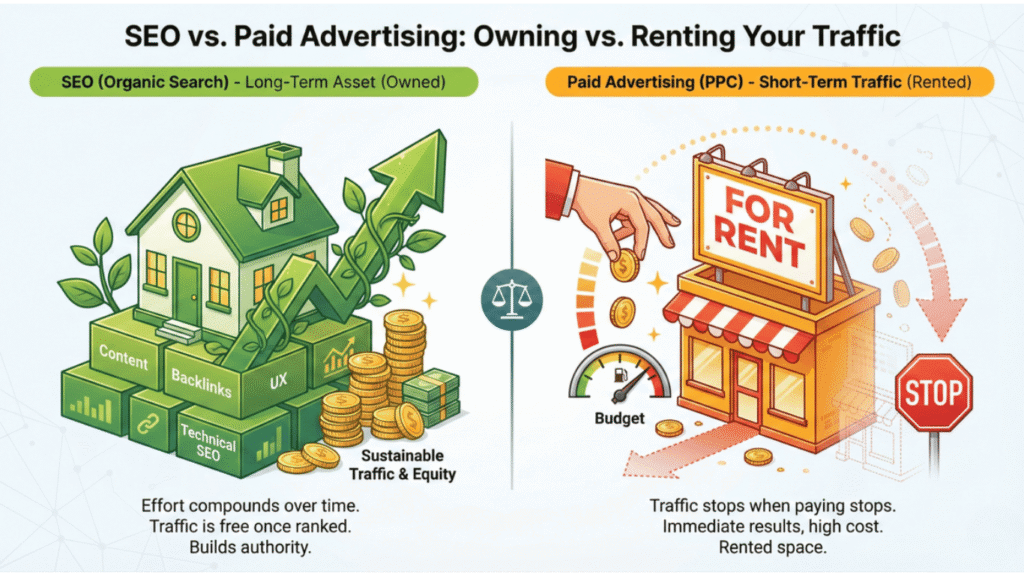
Paid advertising is great for quick results. You pay money, and your site appears at the top instantly. However, it has a major flaw: It is like renting a house.
The Trap of "Rented" Traffic
SEO is Like "Owning" Your Home
- Compounding Returns: The blog post you write today can attract visitors next week, next month, and even three years from now. You do not have to pay five rupees every time someone clicks on it.
- Lower Cost Over Time: Although SEO takes hard work and time at the start (to write content and fix technical issues), it becomes much cheaper in the long run because the visitors you get are essentially “free.”
5. SEO Impacts the "Buying Journey"
- Awareness (The Problem): The user knows something is wrong. They search, “Why does my back hurt while working?” If you have written a blog post about “posture and office chairs,” they find you. You have now introduced your brand as a helpful expert.
- Consideration (The Solution): Now they know they need a chair. They search, “Best ergonomic office chairs 2025.” If your product page or review article ranks here, they see your chair listed among the best.
- Decision (The Purchase): They are ready to buy. They search, “[Your Brand Name] chair reviews” or “discount code for [Your Brand].” appearing here ensures you close the sale.
6. Local SEO Drives Sales to Physical Shops
f you own a physical storefront, a restaurant, a dental clinic, or a service-based business (like a plumber or electrician), SEO is absolutely necessary for your survival.
With the rise of smartphones, the way people find local businesses has changed. We no longer look at phone books. We search “coffee shop near me” or “digital agency in [City Name].”
Capturing “High Intent” Locals
People who perform these searches have very high intent. They are usually ready to buy or visit right now.
- The “Map Pack”: Have you seen the map that pops up at the top of Google with three business names? That is Local SEO (specifically your Google Business Profile). If you are not in that map pack, you are invisible to local customers.
- Operating Hours & Reviews: Local SEO ensures that when someone searches for you, they see your correct opening hours, your address, and your positive 5-star reviews.
Voice Search is Growing
Think about Siri, Alexa, or Google Assistant. When you ask, “Hey Google, find me a pizza shop nearby,” the assistant uses Local SEO data to give you an answer. If your local SEO is weak, the digital assistant will suggest your competitor instead of you.
If you don’t optimize for local search, the customers walking right past your building won’t even know you exist.
Conclusion
So, to summarize: Why is SEO important?
It is not just about computer tricks or technical jargon. It is about ensuring your business exists in the modern digital era. It bridges the gap between your products and the people who are actively looking for them.
From building credibility and trust to improving your website’s usability and delivering a higher return on investment than paid ads, the benefits of SEO for business are undeniable. It transforms your website from a static digital brochure into a 24/7 salesperson that never sleeps, never takes a holiday, and is always ready to greet new customers.
If you want to future-proof your business, the best time to start investing in SEO was yesterday. The second best time is today.
FAQ About SEO
How long does it take to see results from SEO?
SEO is not magic; it is a long-term process. Unlike paid ads which work instantly, SEO usually takes 3 to 6 months to show significant results. This is because Google needs time to “read” your new content, see that users like it, and trust your website enough to rank it on page one. Think of it like planting a tree—you have to water it for a while before you get fruit.
Can I do SEO myself, or do I need to hire an expert?
You can do the basics yourself! Writing good articles, using the right words (keywords), and making sure your site looks good on mobile are things you can start today. However, for the technical parts—like fixing website code, improving server speed, or building backlinks—it is often better to hire an agency or an expert to ensure you don’t accidentally break your site.
I have a Facebook and Instagram page. Do I still need SEO?
Yes, absolutely. Social media is great for building a community, but Search (SEO) is where people go when they want to buy something or solve a problem.
Social Media is like a party: People hang out there, and they might see your product by accident.
SEO is like a store: People come there specifically because they are looking for what you sell. For the best results, you should use both.
Is SEO a one-time process?
No. SEO is like going to the gym. You cannot go to the gym for one month, get fit, and then stop forever. If you stop doing SEO, your competitors will eventually overtake you, and your rankings will drop. To stay on page one, you need to regularly update your content and keep your website healthy.
Why are my competitors ranking higher than me?
There are usually three reasons for this:
Age: They might have been online longer, so Google trusts them more.
Content: They might have more helpful or detailed articles than you.
Backlinks: Other websites might be linking to them, which acts as a “vote of confidence” for their site. An SEO audit can help you find out exactly why they are winning and how to beat them.
Does SEO cost money?
Clicking on an organic search result is free (unlike ads where you pay for every click). However, “doing” SEO costs time or money. You either pay with your own time (writing and fixing things yourself) or you pay money to hire a professional to do it for you. But compared to ads, the long-term cost is much lower.
How do I know if my website actually has SEO problems?
You can start by searching for your own business name or products on Google. If you don’t see your website, you definitely have a problem. While there are free tools that give you a score, they can be confusing to read if you aren’t technical. The most accurate way to find out is to get a Free Website Audit. This is where an expert reviews your site and gives you a simple list of exactly what needs to be fixed, so you don’t waste time guessing.
Is it better to use an automated SEO tool or hire a person?
Automated tools and plugins (like those on WordPress) are great for the basics, like checking your spelling or adding keywords. However, tools cannot think creatively. They cannot build a strategy for your specific business or understand your local competitors. A human expert (or agency) acts as a partner—they don’t just fix errors; they create a long-term plan to help you actually grow your sales, not just your traffic scores.
What are the best free tools to start with?
You don’t need expensive software to start understanding your SEO. Google provides incredible free tools that every website owner should use.
-
Google Search Console: This is the most important tool. It acts like a “health check” for your website, telling you exactly how many people see your site on Google and alerting you if there are technical errors.
-
Google Analytics: This tells you who is visiting your site, where they are coming from (social media vs. search), and which pages they look at the most.
-
Google Trends: A great tool to see what topics are popular right now so you can write content that people are actually searching for.
While these tools give you the data, the challenge is often understanding what that data means and how to act on it. That is where an SEO professional can help translate these numbers into a clear plan.